Skip to content
Cabinet 21 Libération

Orthodontic practice near Paris

Malocclusion: what are its different forms?

The dental malocclusion désigne une mauvaise relation entre les arcades dentaires : surplomb, supraclusion, prognathie, occlusion croisée, infraclusion, protrusion, encombrement ou diastème. Notre cabinet d'orthodontie à Rueil-Malmaison diagnostique et traite ces troubles complexes touchant aux dents, aux articulations des mâchoires et aux muscles.

← Back to the blog

Normal occlusion

In a normal dental occlusion (Angle Class I), the teeth are well aligned and allow the mouth to close properly. Ideally, the lower teeth are covered by the upper teeth over a third or a quarter of their height: this is the reference alignment that every orthodontic treatment in Rueil-Malmaison aims for.
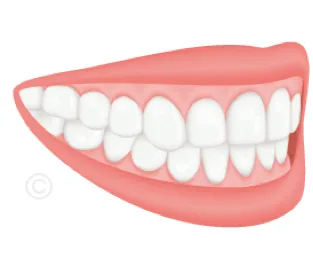
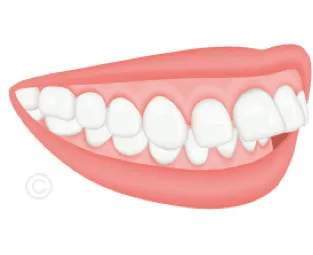
Schéma d'une occlusion dentaire normale (classe I) — orthodontiste Rueil-Malmaison
Normal dental occlusion (Angle Class I): ideal alignment of the dental arches.

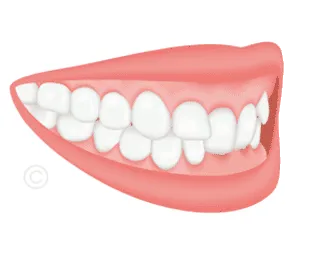
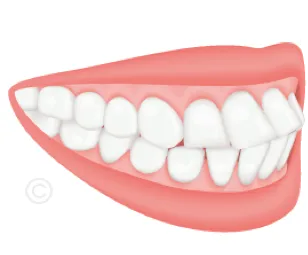
Horizontal overjet

Overjet (Angle Class II) is the horizontal distance between the upper and lower central incisors. This malocclusion, common in both children and adults, is effectively treated with a suitable orthodontic appliance.

Possible consequences:

  • Palatal bite : When the upper teeth cover the lower teeth too much, it results in injury to the palatal mucosa.
  • Trauma : The risk of incisor trauma (for example during sport) is very high, because the lips are not in position to protect the teeth and the upper teeth do not rest in front of the lower teeth.
  • Crowding : Lack of space or crowding in the posterior dental segments.
  • Temporomandibular joint disorders : Due to crowding or jaws that do not fit together properly, the temporomandibular joint can be subjected to stress factors, generating joint noise, pain and even locking.
  • Tooth wear : As the teeth do not fit together properly, premature and excessive tooth wear can occur. It is not uncommon to see dental crowns sharply cut down in young adults.
Schéma d'un surplomb horizontal (classe II) — malocclusion dentaire
Overjet (Angle Class II): upper incisors positioned ahead of the lower ones.

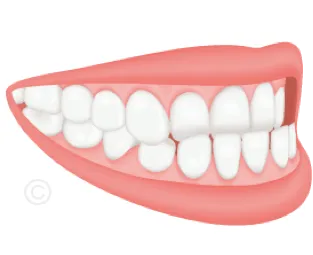
Deep bite

Deep bite (supraclusion) is a vertical malocclusion visible when the upper incisors excessively overlap, or even completely hide, the lower incisors. Orthodontic treatment aims to restore a physiological overlap and protect the gums and the jaw joint.

Possible consequences:

  • Palatal bite : The lower jaw incisors reach the upper gum and injure the palatal mucosa. The upper incisors can also touch and injure the lower gum.
  • Trauma : The risk of incisor trauma (for example during sport) is very high.
  • Crowding : Since the jaws do not fit together properly, the teeth can be subject to displacement or overlap resulting in visible crowding.
  • Temporomandibular joint disorders : The joint can be subjected to stress factors, generating joint noise, pain and even locking.
  • Tooth wear : Premature and excessive tooth wear can occur.

Depending on the severity of the deep bite, only your orthodontist in Rueil-Malmaison can suggest the appropriate type of orthodontic appliance (fixed braces, clear aligners, removable devices).

Schéma d'une supraclusion : les incisives supérieures cachent les inférieures
Deep bite: excessive vertical overlap of the lower incisors.

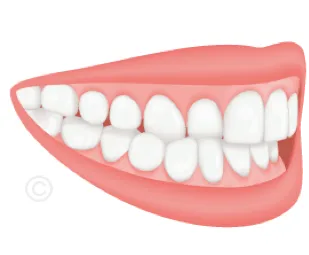
Prognathism

Mandibular prognathism ("protruding chin", Angle Class III) is detected when the lower front teeth sit ahead of the upper incisors. This rarer skeletal malocclusion calls for an early orthodontic diagnosis to make the most of the treatment options.

Possible consequences:

  • Incisor wear : Rapid wear of incisor enamel.
  • Temporomandibular joint disorders : Prognathism causes pain and can lead to disorders of the jaw joint.
  • Tooth spacing : Appearance of gaps between teeth.

Today, orthodontic techniques have evolved: patients are no longer required to wear external appliances to treat prognathism. Treatment duration is also shorter.

Schéma d'une prognathie : dents inférieures avancées par rapport aux supérieures
Prognathism (Angle Class III): lower jaw projected forward.

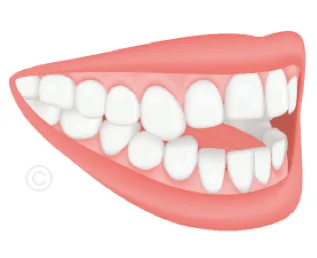
Crossbite

In a crossbite, the lower teeth are closer to the cheek than the upper teeth: they are in a reversed position. When detected early by the orthodontist, this transverse malocclusion is effectively corrected during growth.

Possible consequences:

  • Asymmetrical facial development : When the dental arches do not fit together, a unilateral crossbite causes the lower jaw to deform towards the crossed side.
  • Tooth wear : Premature and excessive tooth wear in young adults.
  • Temporomandibular joint disorders : Joint noises, pain and locking occur when the jaws do not fit together properly.

Feel free to discuss it with your orthodontist during a consultation at the practice in Rueil-Malmaison.

Schéma d'une occlusion croisée : dents inférieures en position inversée
Crossbite: lateral reversal of the dental arches.

Open bite

Open bite (anterior open bite) is visible when the front teeth do not touch with the mouth closed. The upper incisors are pushed outwards and upwards, which impairs chewing and the appearance of the smile.

Possible consequences:

  • Aesthetic consequence : In most cases, a clear lengthening of the face is visible.
  • Tooth wear : As only the back teeth are in contact, patients suffer from sometimes excessive wear.
  • Temporomandibular joint disorders : Pain is caused by the pressure exerted on the joint.
  • Chewing difficulties : Patients' chewing capacity becomes reduced.
Schéma d'une infraclusion : les dents antérieures ne se touchent pas
Open bite (anterior): no contact between the front teeth.

Protrusion

Dental protrusion means the front teeth are tilted forward. This malocclusion weakens the periodontium and encourages gaps between the teeth; orthodontic treatment can reposition the incisors.

Possible consequences:

  • Tooth spacing : Appearance of gaps between teeth.
  • Attachment loss : Long-term appearance of gum recession.
Schéma d'une protrusion : dents antérieures penchées vers l'avant
Protrusion: forward tilt of the front teeth.

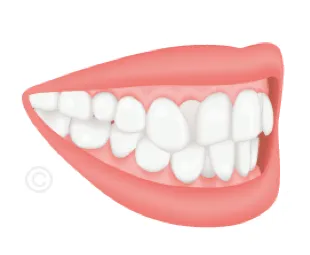
Crowding or overlapping teeth

A lack of space on the arch causes overlapping or crowded teeth. Almost every bite shows some degree of crowding; a panoramic X-ray allows the orthodontist to assess tooth position and propose a treatment plan (extraction, expansion, alignment with fixed braces or aligners).

Possible consequences:

  • Increased risk of cavities : As there is not enough space, brushing the teeth becomes difficult.
  • Attachment loss : Tooth displacement out of the bone can cause gum recession to appear.
  • Tooth wear : Failure to treat dental crowding in young adults causes premature wear.
Schéma d'un encombrement dentaire : chevauchement des dents par manque de place
Dental crowding: overlapping teeth due to lack of space on the arch.

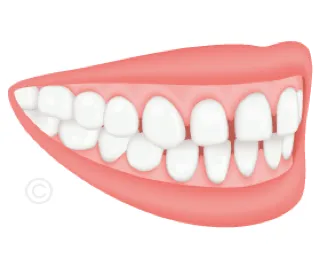
Tooth spacing or diastema

Unlike crowding, excess space creates gaps between the teeth (diastemas), often called a "gap-toothed smile". These gaps make brushing harder and can encourage gum disease: orthodontics can close the diastemas and harmonise the smile.

Possible consequences:

  • Tooth displacement : Since the teeth are not naturally interlocked, they move in an uncontrolled way.
  • Attachment loss : Appearance of gum recession.
  • Tooth wear : This tooth wear is caused by the fact that the teeth are not interlocked.
  • Posterior spacing : Failure to treat this malocclusion causes chewing problems.
Schéma d'un diastème : espaces inter-dentaires (« dents du bonheur »)
Diastema: excessive gaps between the teeth ("gap-toothed smile").

Located in Rueil-Malmaison, not far from Paris, our dentiste andorthodontie vous accueille dans un cadre rassurant et agréable. Book an appointment.